 IDSP-Pakistan
 A scholar that was
February 4, 2010A scholar that was
By Rafi Ullah
Courtesy to "The News"
Students of
ancient South Asian history often encounter names such as Panini and
Kautilya. It was due to the rich culture of learning and research
that ancient Pakistan attracted students from all over the world to
its centres of scholarship with Taxila being one of the most advanced
universities of the time. In modern Pakistan, it abundantly goes to
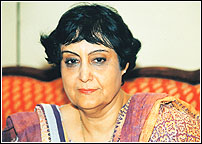
the credit of the late Dr Ahmad Hassan Dani who has in large part dug
out the historical roots of the country and its people. To call him
the repository of the history, archaeology, anthropology and
linguistics of the area would not be an exaggeration.
What makes Professor Dani an intellectual of unmatchable stature is his deep understanding of the local knowledge and conventional wisdom in addition to a hold over modern scientific education. From this vantage point, he interpreted the process of continuity and change in the long history of Pakistan.
Dr Dani’s professional career started in 1945 under the supervision of the famous archaeologist, Sir Mortimer Wheeler. In the wake of partition he migrated to East Pakistan and served there in different capacities such as curator at Dhaka Museum and Assistant Professor at the University of Dhaka. In 1962, he joined the University of Peshawar as professor and founded the Department of Archaeology there. From 1971 till his death in 2009, Professor Dani served in the Quaid-i-Azam University Islamabad. Here he remained associated with the departments of History, Anthropology and the Taxila Institute of Asian Civilisations. It is in recognition of his life-long services that he was honoured with the title of Professor Emeritus.
The Taxila Institute of Asian Civilizations owes a lot to Professor Dani. The establishment of the Institute tells the story of his lofty scholastic ideals. Dr Dani had a dream of founding a university at Taxila, the place which he believed was home to the first ever university of the world, dedicated to scholarship and research in Asian Civilizations. As a first step towards the realisation of his ideal, he established "Centre for the Study of the Civilisations of Central Asia" – which was later renamed as the "Taxila Institute of Asian Civilizations" – at the Quaid-i-Azam University, Islamabad. The institute has been an important centre of study and research and has a research journal entitled "Journal of Asian Civilizations" (formerly Journal of Central Asia).
Dr Dani
weaves the social and cultural threads of the people of Pakistan with
their long forgotten past. He states, "The geographical locale
of Pakistan has determined the movements of peoples along with whom
their cultures have followed. It is the inner capacity of the Indus
valley which has absorbed both of them and it is out of this ethnic
intermixture and cultural intermingling that a new Indus pattern has
developed. That pattern is the heritage that belongs to the people of
Pakistan." (History of Pakistan: Pakistan through Ages)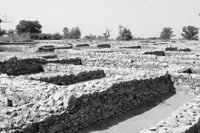
Second, Dr. Dani makes generous use of interpretation in respect of his archaeological findings. But it should be remembered that he makes interpretations in the light of all the historical developments that have taken place in Pakistan. His deep familiarity with these events and his speculative reasoning is clearly reflected in the passage below:
"Thus in this long period of history several political changes took place and brought in foreign rulers who exercised outside influences. The period began with the rule of the Achaemenians; followed by that of Alexander the Great, and with a short break of the Mauryan rule, there came about the long period of the Bactrian Greeks, the Scythians, the Parthians, the Kushans, the Huns and finally Turki Shahis and Hindu Shahis. All of them exerted great cultural influences which have left unforgettable legacy to present Pakistan. They helped in the creation of the Golden Age of Gandhara and they gave a new basis to the development of Buddhism into a new type called Mahayana Buddhism. Towards the closing years this was replaced by Hinduism, which has left behind many Hindu temples all over the region. In some parts of Balochistan and Northern Areas of Pakistan Zoroastrianism was followed and it left deep influence behind in the ritual practices, shrines and rock carvings, which all became dormant and gradually forgotten in human memory with the coming of Islam."
Dr Dani was also well-aware of the importance of the movements of the people in history. Thus, he sees the development of civilisation in Pakistan as a process of syncretism, assimilation and amalgamation. In his article, Contribution of Gandhara to World Civilization, he writes: "Human civilisation is a product of human ingenuity. Wherever genius of man has had new ideas and the means to execute these ideas into useful creations, there has been progress towards new goals of civilisation. Such ideas originate from intermixing of humans and exchange of views among them. However, these activities happen when new opportunities open the road of free mixing, collaboration and cooperation. Such opportunities arise both as a result of war or in the development of peace which human beings desire to establish for the betterment of mankind."
"Such an opportunity arose with the conquest of Gandhara by the Achaemenian Iranians when the two civilisations of this subcontinent and of Western Asia met in the land of Gandhara. Whether as a result of this, or in addition to this opportunity, the famous University of Takshasila [Taxila], if not originated, at least received new impetus, and the doors were opened for the common pursuit of human knowledge and towards making new contributions to the progress of human civilisation."
The purpose of this short article in the memory of Professor Dani on the eve of his first death anniversary is to remind all of the legend we had among us. We may follow in his footsteps and imitate his multi- and interdisciplinary approach in the study and research of our histories, cultures and societies.
The writer is lecturer at the Taxila Institute of Asian Civilizations, Quaid-i-Azam University, Islamabad. Email: rafi_ula@yahoo.com
Posted by ADP. Posted In : Rafi Ullah's Articles