 IDSP-Pakistan
 US Congressional hearing may spell trouble for Pakistan
February 16, 2012
Published: 9th February, 2012 Dawn.com
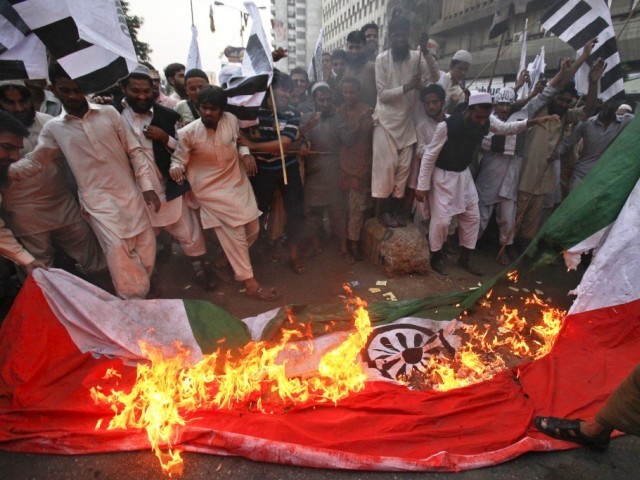
While some officials from the government and non-governmental organisations have only expressed concern over the situation, other individuals, including former army soldiers, State department officials and members of the US Congress, have now begun to publicly assert support for an independent Balochistan. —Photo by Reuters
The United States (US) Committee on Foreign Affairs is set to convene a congressional hearing on Wednesday (February 8), for an exclusive discussion on Balochistan.
The extraordinary event has generated great interest among followers of Pakistan-US relations, as the allies’ mutual relationship seems to be deteriorating. The powerful House of Representatives committee oversees America’s foreign assistance programs and experts believe it can recommend halting US assistance to Pakistan over human rights violation in Balochistan.
Calls for ‘independence’
While
Islamabad has strictly treated Balochistan as an internal matter, the
debate on such a divisive topic by the powerful committee has
highlighted the level of American interest in Balochistan and its
support, if any, for the nationalist movement. On its part, Pakistan has
kept Washington at arm’s length on the Balochistan issue, by refusing
to grant it permission to open a consulate in Quetta.
A Republican Congressman Dana Rohrabacher, who recently co-authored an article with Congressman Louie Gohmert expressing support for an independent Balochistan, will chair the hearing.
“Perhaps we should even consider support for a Balochistan carved out of Pakistan to diminish radical power there (in Pakistan),” Rohrabacher wrote in his piece.
According to Asia-Pacific Reporting Blog, “it is expected that the hearing will tackle issues related to whether or not the US Congress should tie human rights issues in Balochistan to Pakistani aid.”
Witness box
Another area of
interest is of the controversial witnesses who will testify before the
committee. The three-member panel comprises of defence analyst Ralph
Peters, Georgetown assistant professor, C. Christine Fair and Ali Dayan
Hasan, Pakistan Director of the Human Rights Watch.
Ironically, the panel on Balochistan does not include a Baloch representative, an issue which has disappointed the Baloch diaspora in the United States, who fear the misinterpretation of their stance by people they view as unfamiliar with the Baloch conflict.
One of the witnesses, Ralph Peters, attracted scathing criticism by right-wing Pakistani strategists in June 2006, when his article Blood Borders was published in the Armed Forces Journal with a map of Free Balochistan. Peters, 59, a former US army officer, is expected to support in his testimony the idea of an independent Balochistan comprising of the Balochistan provinces in Pakistan and Iran and parts of Afghanistan.
On the other hand, Dr Christine Fair is known as a passionate supporter of Pakistan with an anti-India stance. The Pakistani media quoted Dr Fair in March 2009, for allegedly linking India with the Baloch insurgency. She was reportedly questioned the role of the Indian consulates in Afghanistan and Iran.
“Having visited the Indian mission in Zahedan,” she told a roundtable organised by the Foreign Affairs magazine, “I can assure you they (Indians) are not issuing visas as their main activity.” Later on, however, she told Outlook, an Indian newsmagazine, in an interview that the Pakistanis had blown her comments out of proportion.
On Twitter, a week ahead of the hearing, Dr Fair called Ralph Peters, the fellow witness, a “nut” and asked “WHAT does he know?” On Saturday, she also irked the Balochs by questioning their majority status in Balochistan while in another Tweet she warned the separatists not to “expect me to support an independent Balochistan”.
Public debate
Dr. Akbar S. Ahmed, Pakistan’s former high commissioner to the United Kingdom, told Dawn.com
that the congressional hearing was a “significant step” in highlighting
Balochistan’s problems. “The information provided in the event,” he
said, “will not only be used by members of the US Congress but will also
be picked up by the world media.”
“The shocking stories of torture and murder in Balochistan will become part of the public debate. It is in the interest of Pakistan to quickly and effectively resolve the situation in Balochistan bringing back the Baluch with honour, respect and dignity,” said Dr Ahmed, who is currently the Ibn Khaldun Chair of Islamic Studies at the American University in Washington DC.
Dr Ahmed, who served in 1980s as the Commissioner of three districts in Balochistan, says the hearing can potentially create a great deal of negative publicity for Pakistan.
Close watchers
In the United States, the conflict in Balochistan has been gaining
remarkable attention of late. While some officials from the government
and non-governmental organisations have only expressed concern over the
situation, other individuals, including former army soldiers, State
department officials and members of the US Congress, have now begun to
publicly assert support for an independent Balochistan.
For instance, on January 15, Victoria Nuland, the State Department spokeswoman, expressed America’s “deep concern” over the ongoing violence in Balochistan, especially targeted killings, disappearances and human rights violations.
“This (Balochistan) is a complex issue. We strongly believe that the best way forward is for all the parties to resolve their differences through peaceful dialogue,” she said.
Last year on November 16, the State Department deputy spokesman, Mark Toner, had also observed during a press briefing, “You know, more broadly, we do have concerns about the situation in Balochistan. We’ve addressed those concerns with the government of Pakistan.”
Nationalist view
Baloch nationalists are cautiously monitoring Wednesday’s hearing.
“To be honest, we are not very optimistic about this meeting,” Sardar Akhtar Mengal, a former chief minister of Balochistan, told Dawn.com, “but both support and attention from the US are significant because the presence of the US cannot be overlooked in South East Asia. It is essential that the US gives attention to Balochistan, as the aid that is given to Pakistan in the name of war against terror is being spent to commit atrocities in Balochistan.”
A political expert in Washington DC, who requested anonymity, said during the election year, the Republicans are likely to bring up the Balochistan issue to castigate Democratic President Barrack Obama for deliberately keeping quiet against Pakistan, an ally in the war on terror, for allegedly misusing American assistance to fight the secular Balochs instead of quashing the Taliban.
After the killing of Osama bin Laden in Pakistan, many American policymakers have become disillusioned with Pakistan and now some of them propose an independent Balochistan to fight religious extremism. Last month, Louie Gohmert, another Republican Congressman from Texas, suggested that the US should, “talk about creating a Balochistan in the southern part of Pakistan…they love us. They’ll stop the IEDs (improvised explosive devices) and all the weaponry coming into Afghanistan, and we got a shot to win over there.”
Sardar Mengal, who leads the largest Balochistan National Party (BNP), says the hearing does not mean that the Washington is going to support the Baloch cause in the future.
“What the US can do for us is to care for the Baloch as human beings. Since Washington is apparently a committed supporter of human rights, it is obligatory that the US should stop the genocide of the Baloch nation by the authorities as it has done in other parts of the world, supporting their right of self-determination.”
M. Chris Mason, a Senior Fellow at the Center for Advanced Defense Studies, who recently retired from the US Foreign Service, has emerged as another ardent proponent of free Balochistan in the United States.
In an article, Mason, who lecturers at the prestigious National Defense University, argued an independent Balochistan would solve many of the [Af-Pak] region’s most intractable problems overnight and would create “a territorial buffer between rogue states Iran and Pakistan.”
“The answer to the current Pakistani train-wreck is… recognising Balochistan’s legitimate claim to independence… to help the Baluchis go the way of the Bangladeshis in achieving their dream of freedom from tyranny, corruption and murder at the hands of the diseased state,” he wrote.
Routine matter
Hassan Abbas, a scholar
based in Washington DC who until recently was Quaid-i-Azam Chair
Professor at Columbia University in New York, seriously doubts if the US
will officially support Baloch nationalists at this time as this will
complicate US-Pakistan relations.
“I think the hearing is a routine matter as all security related issues in Pakistan are being analysed in the policy world with keen interest as well as concern. The hearing will discuss human rights issue as well as politics,” says Abbas, who is also a Senior Advisor at Harvard University’s Kennedy School of Government, “but the hearing itself will not create any serious diplomatic row. The US Congress must listen and understand that there is a variety of perspectives on the subject.”
Dr Ahmed, meanwhile, attributes the deepening crisis in Balochistan to Islamabad’s failure to understand that time is running out for it.
“The leaders of Pakistan are so focussed on the power struggles in Islamabad that they seem to have little will or imagination to deal with the urgent issues that concern the country’s largest province of Balochistan.”
How will Islamabad respond to the hearing?
“Pakistan’s establishment is quite sensitive about the Balochistan
crisis and they will follow the hearings closely and sceptically,” says
Hassan Abbas, whose book Pakistan’s Drift into Extremism was published in 2005.
According to Abbas, hawkish elements in Pakistani media are likely to create a lot of hue and cry over the hearing. Yet he cautions, “They will serve Pakistan better by focussing on projecting the concerns of the ordinary Baloch people, who are disenfranchised, distressed and increasingly getting disenchanted.”
Sardar Mengal of BNP, who was detained in Karachi for several months during the Pervez Musharraf regime, predicts there would be a definite reaction from the government.
“They can only display their superiority to the ones who are weaker, and in this case, the Baloch are the weaker ones,” he says and warns, “But if there is a reaction from Pakistan toward us, this time it will be once and for all. Either the Baloch will swim across or sink as a nation.”
The writer is a freelance journalist based in Washington DC and the author of The Redefined Dimensions of the Baloch Nationalist Movement.
Posted by ADP.


 The Difa-i-Pakistan rally was a combination of both: the Taliban with
and without beards. The common denominator is that they both support
the establishment’s use of religious bigotry in foreign as well as
domestic policies of Pakistan
The Difa-i-Pakistan rally was a combination of both: the Taliban with
and without beards. The common denominator is that they both support
the establishment’s use of religious bigotry in foreign as well as
domestic policies of Pakistan
 This popular form of Islam is more widespread than the hardline and
extremist version of Wahabiism, which is followed by today’s Taliban and
al Qaeda
This popular form of Islam is more widespread than the hardline and
extremist version of Wahabiism, which is followed by today’s Taliban and
al Qaeda